A low dress quote can feel exciting. The real bill can arrive later. I have seen boutique buyers lose margin when landed cost was not clear.
The cost to import wedding dresses from China is the landed cost, not only the factory price. I calculate it as dress price, China local freight, international freight, duties, customs fees, and final delivery to the bridal store.
Many bridal shop owners ask me one simple question first: “How much is one wedding dress?” I understand that question. I also know it is not enough. In our factory in Xiamen, we handle sample orders, small-batch orders, FOB quotes, production updates, and shipment talks with overseas bridal shops every week. I have learned that the lowest unit price is not always the safest buying decision. A boutique must know what the dress costs when it reaches the store, not only when it leaves the factory. That is where the real budget starts.
Why should I calculate landed cost instead of only factory price?
A cheap factory price can hide later costs. The danger is simple. I may save $30 on the dress, then lose $150 in freight or duty.
I calculate landed cost because it shows the real cost of one imported wedding dress after purchase price, freight, duty, customs clearance, and local delivery are included. It helps a bridal boutique protect margin and compare suppliers fairly.
When I discuss cost with boutique bridal shops, I always try to move the talk from “unit price” to “landed cost.” A wedding dress is not like a small accessory. It has volume. It often needs careful packing. It may ship by air for samples or urgent styles. It may ship by sea for larger seasonal orders. Each choice changes the final cost.
I use this basic formula when I explain the budget:
Landed Cost = Wedding dress purchase price + China domestic freight + international freight + import duties/tariffs + customs clearance fees + destination domestic delivery.
This formula does not make the price higher. It only makes the cost clearer. A buyer can then decide if the dress still fits the target retail price, sample plan, and cash flow.
| Cost Item | What I Mean | Why It Matters To A Boutique |
|---|---|---|
| Dress purchase price | The factory cost of the dress | This affects base margin |
| China domestic freight | Delivery to a port, airport, or export point | This depends on trade term |
| International freight | Air, sea, express, or consolidated shipment | This can change a lot by quantity |
| Import duties and tariffs | Charges based on customs rules | This must be checked before import |
| Customs clearance fees | Broker or handling fees | This can appear even on small orders |
| Local delivery | Delivery from arrival point to the shop | This affects the true store cost |
I still remember a small boutique that compared two sample quotes from different factories. One quote looked lower by about $40 per dress. But the buyer did not check the shipping method and trade term at first. After adding freight and handling, the lower quote was not lower anymore. That is why I prefer a clear cost sheet, even if it takes more time at the start.
What does FOB usually include when I buy wedding dresses from China?
FOB can look simple, but it has limits. If I do not ask what it covers, I may confuse port cost with door delivery.
FOB usually means the factory price includes delivery to the Chinese port or export point, but it does not include international freight, import duties, customs clearance, or inland delivery in the destination country.
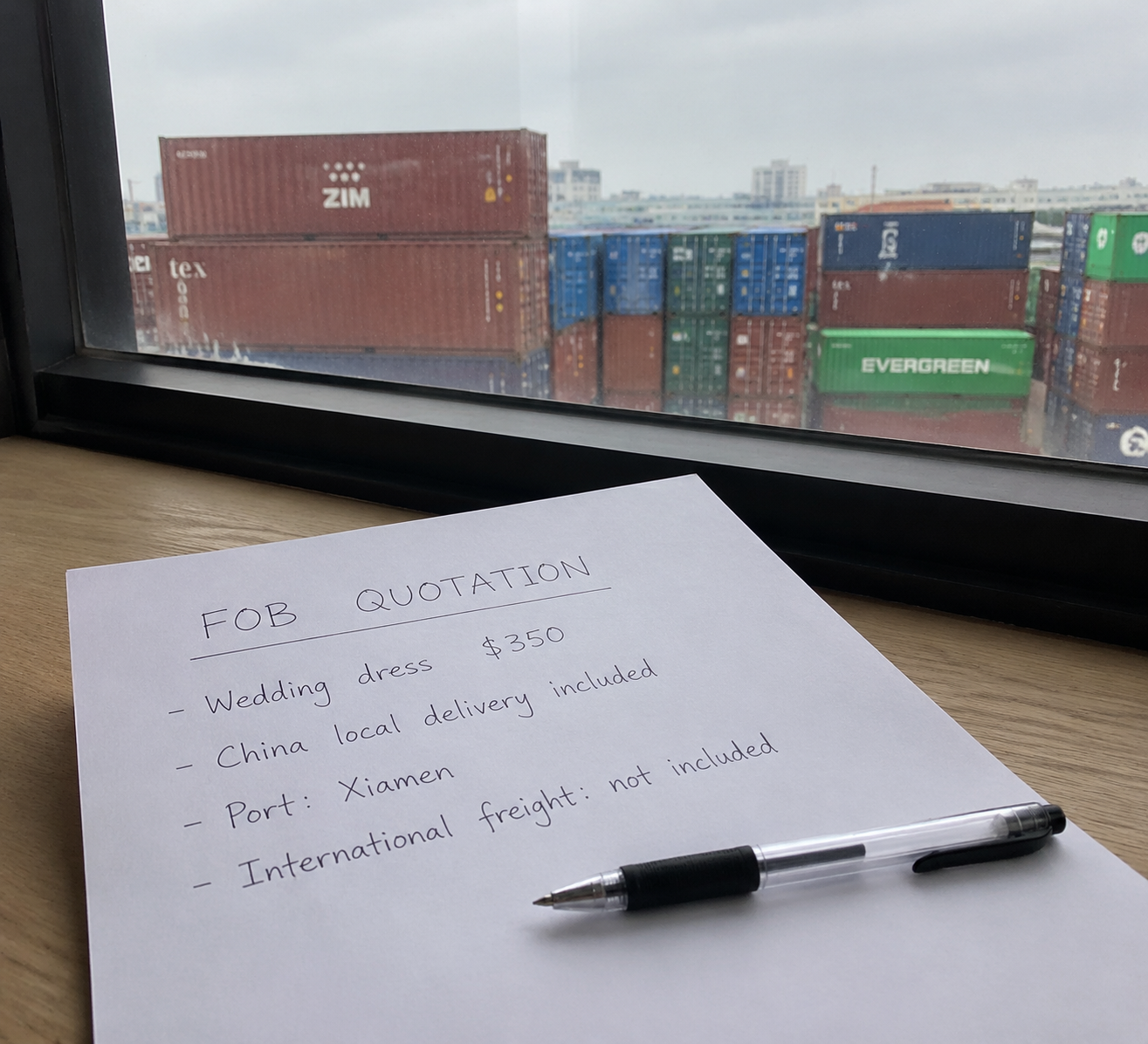
In our daily work, FOB is one of the most common trade terms used in wedding dress export quotes. Many buyers see “FOB China” and think most shipping cost is already included. That is not always true. In many factory quotations, FOB means we take care of the goods until they reach the agreed Chinese port or export point. It may include China-side delivery and export-related handling, based on the exact quote. It does not mean the dress will arrive at the boutique door.
I always tell buyers to ask one direct question: “What exactly is included in this FOB quote?” This question saves trouble. Different factories may explain details in different ways. A clear written answer is better than a verbal promise.
| FOB Cost Area | Often Included? | What I Ask Buyers To Confirm |
|---|---|---|
| Dress production cost | Yes | Does it include labels, hangtags, garment bags, or custom packaging? |
| China local delivery to port | Usually yes | Which port or export point is used? |
| Export documents | Often yes | Which documents are provided? |
| International freight | No | Who books the freight? |
| Destination customs clearance | No | Who handles the broker? |
| Import duties and tariffs | No | Who pays them? |
| Domestic delivery after arrival | No | How will the goods reach the bridal shop? |
FOB works well for buyers who have a freight forwarder or who want control over shipping. It can also be useful for boutiques that plan to consolidate gowns with veils, evening dresses, or other bridal products. But FOB can cause surprises if the buyer thinks the quote is a final import cost. I am not a customs broker or freight forwarder, so I do not present FOB as a complete door-to-door cost. I can explain what our factory side includes. I can also help prepare packing details, carton size, gross weight, and documents that the buyer or forwarder needs.
Is DDP easier than FOB for a bridal boutique?
DDP may feel easier because one quote looks complete. The risk is that “door delivery” can still have unclear details if I do not check.
DDP may include delivery to the buyer’s address, but I still confirm who handles customs, whether duties are included, what address is covered, and whether any later local charges may appear.
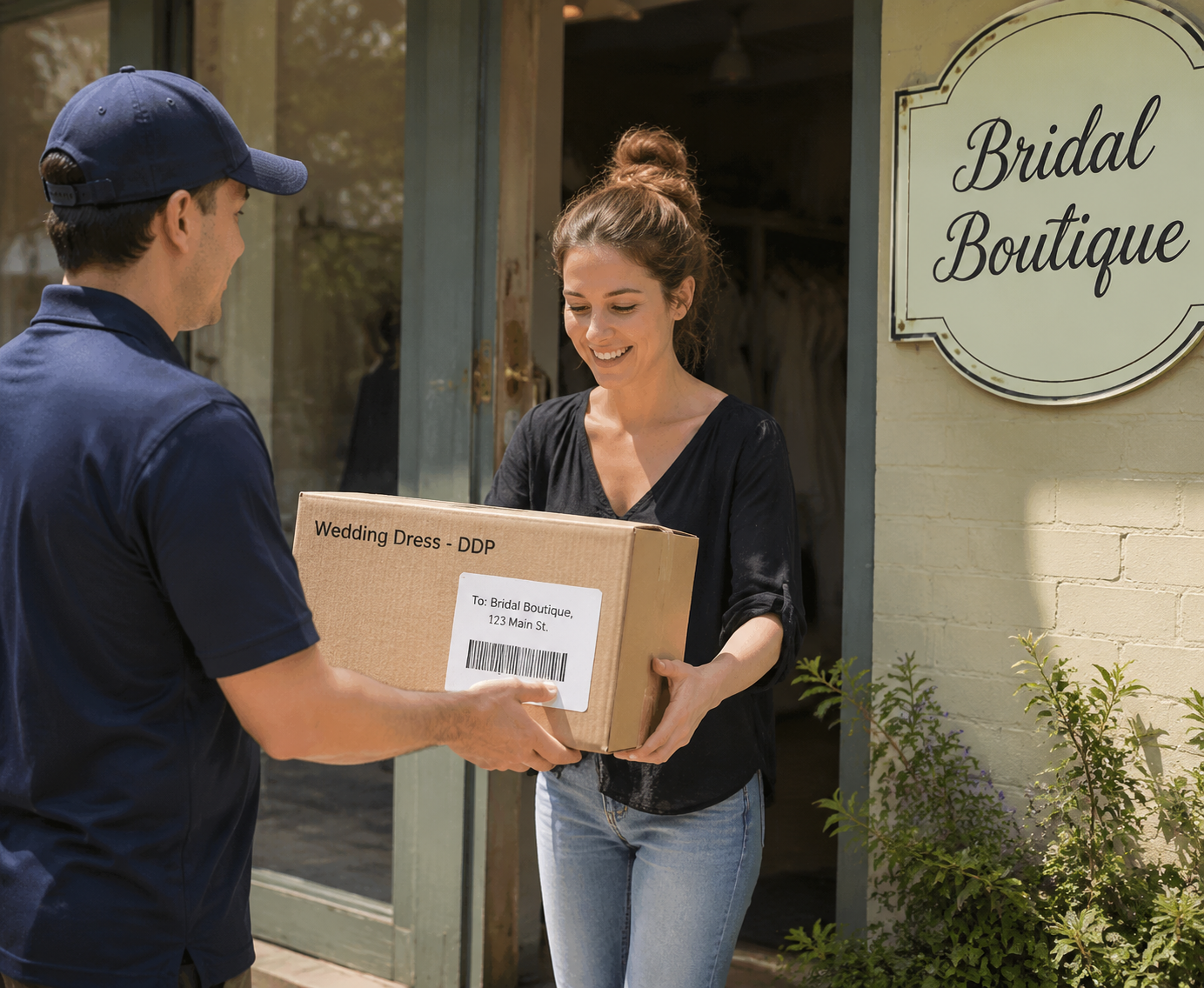
Some boutique owners prefer DDP because they want a simple number. I understand that. A bridal shop owner already has many things to manage. She may handle appointments, alterations, sample buying, trunk shows, staff training, and cash flow. A DDP quote can feel easier because it may cover delivery to the shop address. But I still treat it with care.
DDP should be checked in writing. I ask what is included and what is not included. I also ask who is responsible if customs asks questions. Some sellers use the word DDP in a loose way. Some freight services include duties. Some may not include special local handling. Some may have limits by product type, declared value, address, or shipment size.
| Question I Ask About DDP | Why I Ask It |
|---|---|
| Does the quote include import duties and tariffs? | Duties can change the final cost |
| Who is the importer of record? | Customs responsibility must be clear |
| Does it include customs clearance? | Clearance delays can affect selling plans |
| Is delivery to my exact shop address included? | Remote area or local delivery may cost more |
| Are there possible later charges? | A boutique needs a clean budget |
| What shipping method is used? | Air, sea, or express affects time and risk |
For a small sample order, DDP or express-style delivery may be practical. It helps a shop test fit, fabric, beading, lace work, and overall workmanship without building a large stock position. Our MOQ 1 is useful here because a boutique can order one gown, inspect the corset structure, check the zipper, see the lace placement, and decide if the style fits its customer base. But for larger seasonal orders, DDP may not always be the lowest or most transparent choice. FOB plus a trusted forwarder may give better control. The best term depends on the buyer’s team, order size, timeline, and risk level.
What landed-cost example can I use for a first estimate?
A rough estimate is helpful, but it can mislead me if I treat it as a fixed price. Each dress and shipment can change the result.
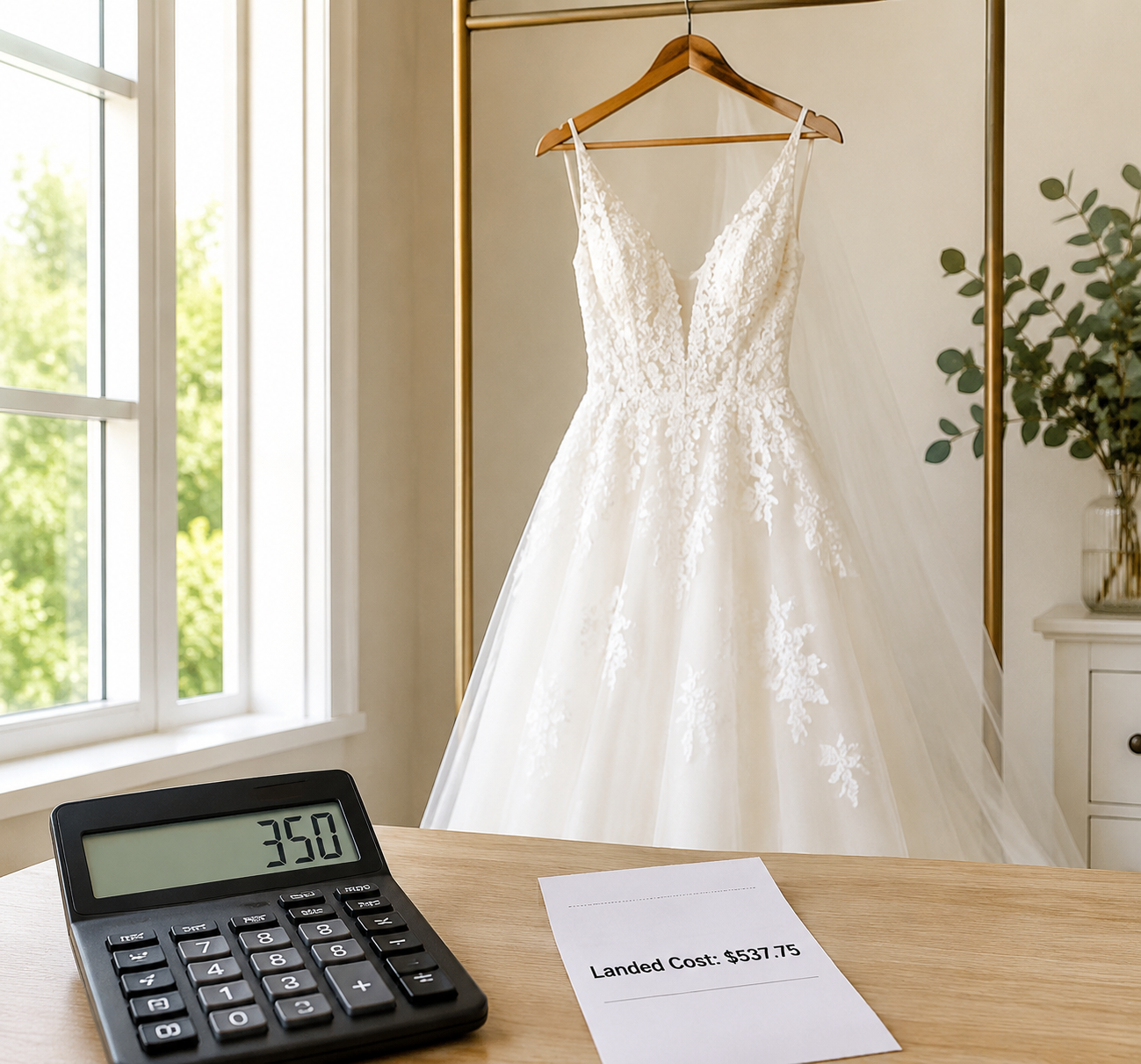
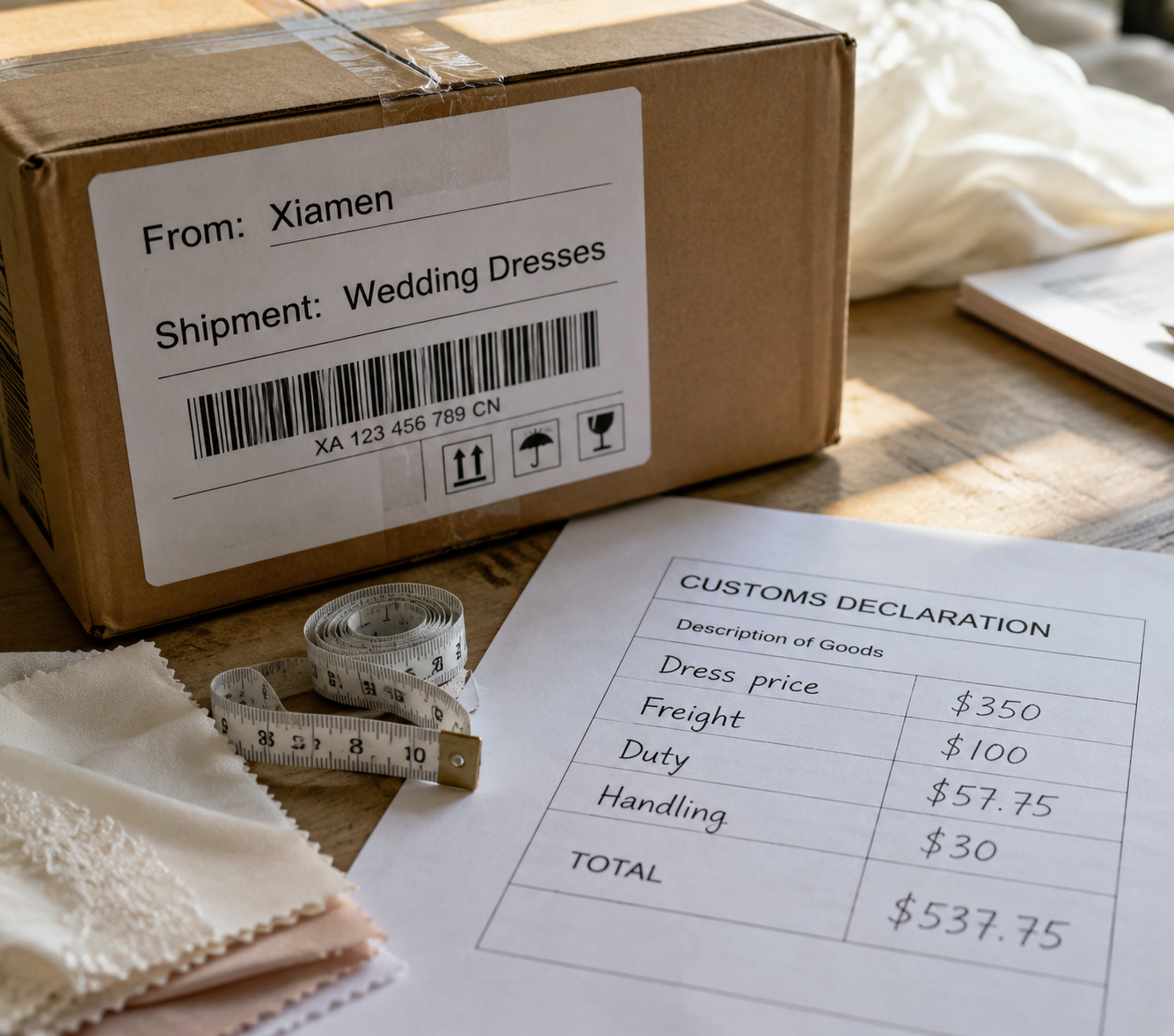
As an illustrative example only, a $350 wedding dress may become about $537.75 landed cost after $100 shipping, $57.75 basic import duty, and $30 clearance or handling fee. Actual cost depends on style, quantity, route, and rules.
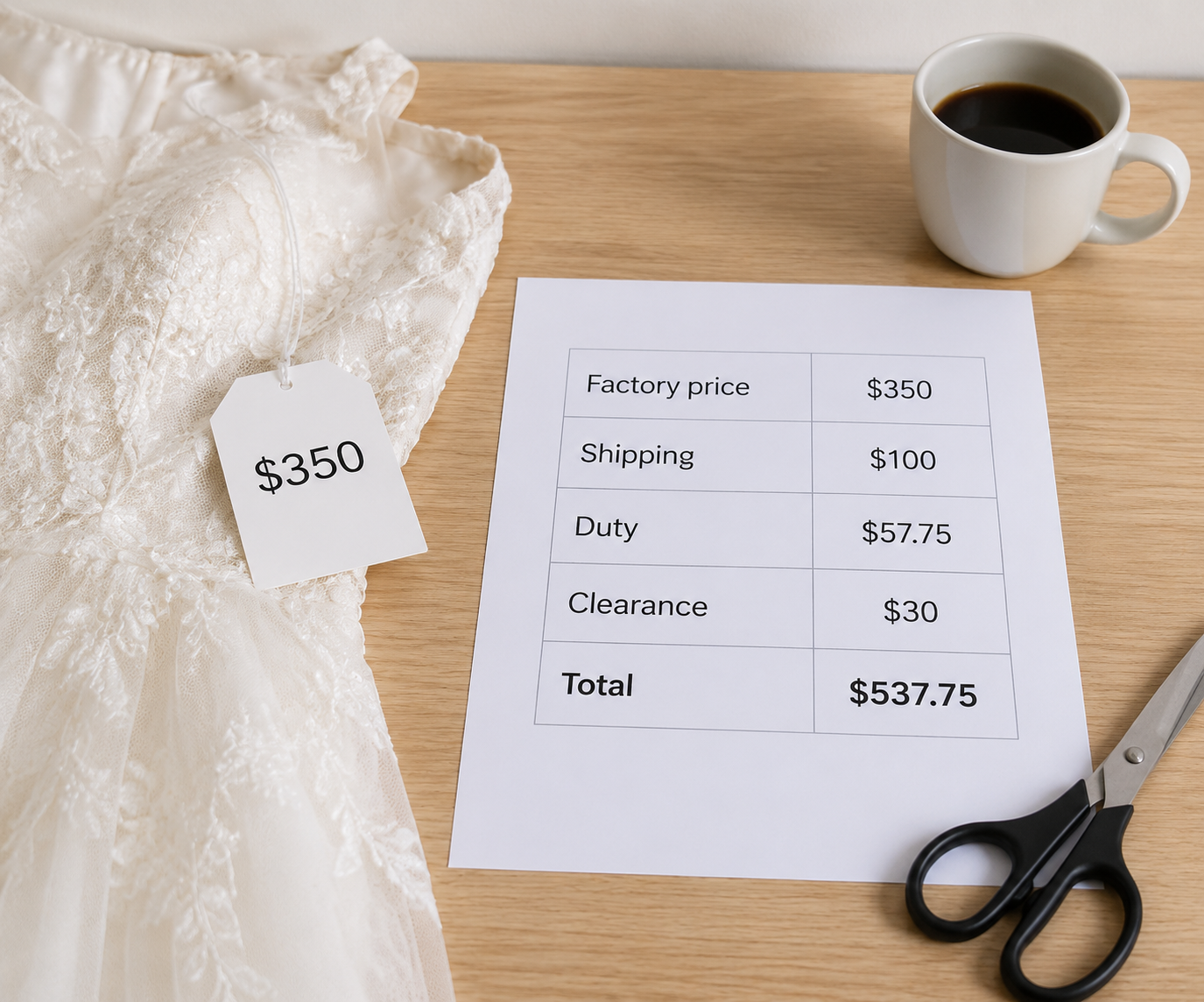
I often use a simple example to help buyers understand the cost build-up. This example is not a universal price. It is not a promise. It is only a way to see how the final number can grow after the factory price.
Let us say one wedding dress has a factory price of $350. The estimated international shipping cost is $100. The basic import duty is estimated at $57.75. The clearance or handling fee is $30. The estimated landed cost becomes $537.75.
| Item | Example Amount |
|---|---|
| Factory price | $350.00 |
| International shipping | $100.00 |
| Basic import duty | $57.75 |
| Clearance / handling fee | $30.00 |
| Estimated landed cost | $537.75 |
This example is useful because it shows the gap between factory cost and store cost. A buyer who only sees $350 may think the dress has a much higher margin than it really does. A buyer who sees $537.75 can make a better retail decision. She can compare it with the target selling price, alteration cost, hanger and garment bag cost, photoshoot cost, and sample aging risk.
For U.S. imports, I always add one important note. Import duties and extra tariffs depend on the applicable HTS classification and the U.S. trade policy in effect at the time of importation. I do not act as a customs broker. I suggest that buyers confirm the duty and tariff position with a licensed customs broker or import specialist before placing an order. This is especially important when buying different gown styles, fabric compositions, or mixed product categories. A satin gown, lace gown, beaded gown, veil, and evening dress may not be treated the same way. The correct classification matters.
How do style, structure, and workmanship change the factory price?
A wedding dress price is not only fabric cost. A simple sketch can become expensive when structure, handwork, and fit work increase.
The factory price changes with silhouette, fabric, lace, beading, corset structure, train length, lining, handwork, size range, and sample development. More structure and more handwork usually mean higher cost.
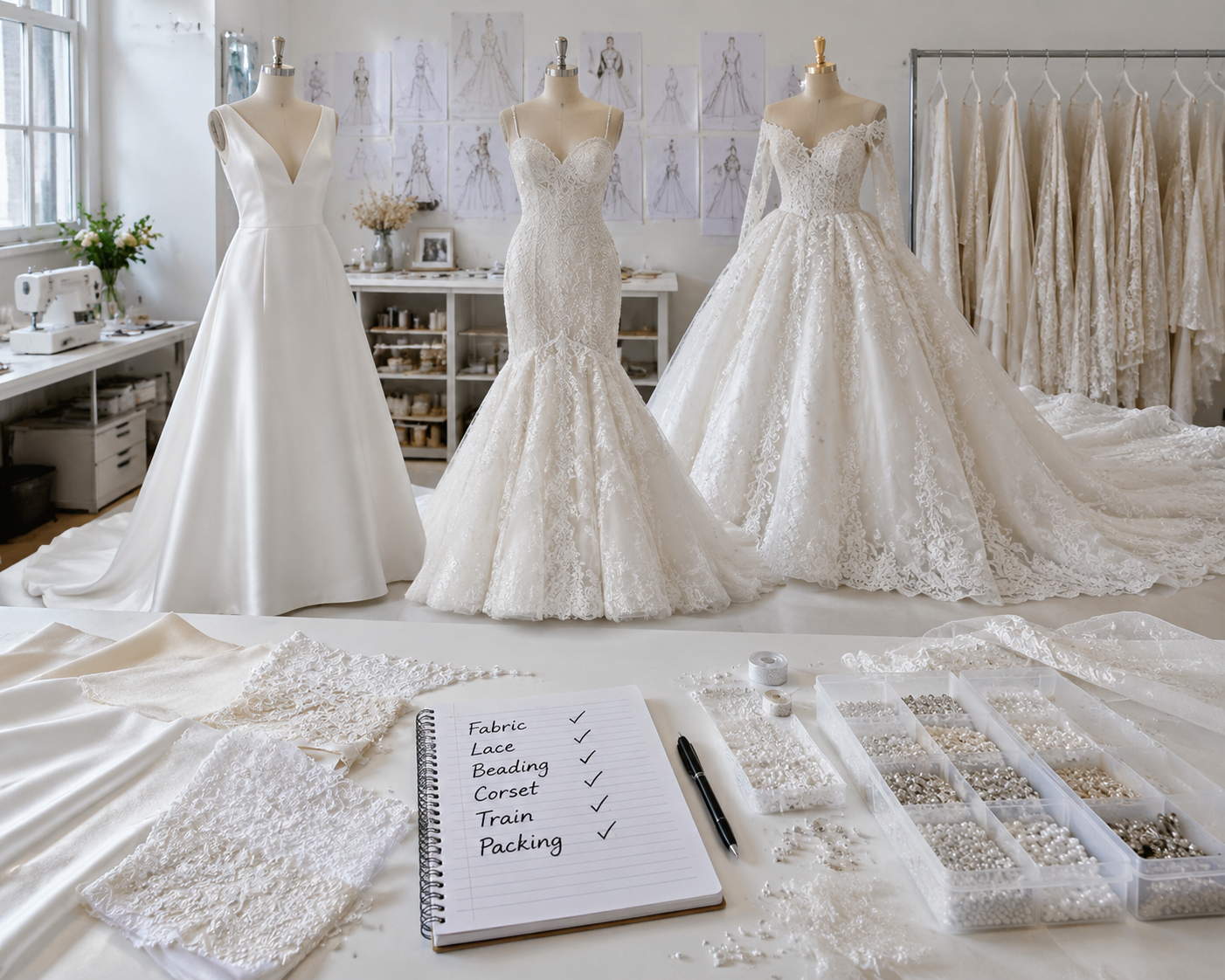
In our factory, we produce A-line gowns, mermaid gowns, ball gowns, and other bridal silhouettes. I see cost differences every day. A clean satin A-line gown may look simple, but it still needs good pattern work and pressing. A beaded mermaid gown may need more cutting care, more sewing skill, and more handwork time. A ball gown with a long train may use much more fabric and take more space in packing. A corset bodice can improve fit and support, but it also needs better structure development.
| Cost Factor | How It Affects Price |
|---|---|
| Silhouette | Ball gowns and long trains often use more fabric |
| Fabric | Satin, tulle, organza, lace, and mesh have different costs |
| Lace and appliqué | More placement work means more labor time |
| Beading | Hand beading increases cost and production time |
| Corset bodice | Boning, cups, lining, and fit work add structure cost |
| Size range | Plus-size grading may need extra fabric and pattern checking |
| Custom changes | Neckline, sleeve, train, and closure changes add development work |
| Packing | Larger gowns need larger cartons and can raise freight cost |
I always ask buyers to share clear photos, reference samples, tech packs, or detailed notes. A vague request like “similar to this luxury style” is not enough for accurate costing. I need to know the fabric, lining, lace type, bead level, construction, size range, and order quantity. If the buyer wants OEM production, we follow the given design more closely. If the buyer wants ODM support, our design and development team can help adjust the structure, balance the price, and improve production feasibility.
This part matters because a low factory price can also mean a quality tradeoff. A boutique may save money on thin lining, weak boning, loose appliqué, or poor pressing. But the shop may pay later through returns, unhappy brides, alteration pressure, or damaged reputation. I prefer to discuss the target market and retail price before quoting. A dress for a high-end appointment room needs different choices from a fast test sample.
Why does MOQ 1 help bridal boutiques control import risk?
A large order can reduce unit cost, but it can also create dead stock. I prefer letting a boutique test before it scales.
MOQ 1 helps a bridal boutique test a wedding dress style, inspect workmanship, check fit, and measure customer demand before placing a larger order. It lowers inventory risk, even if the first sample cost is higher.
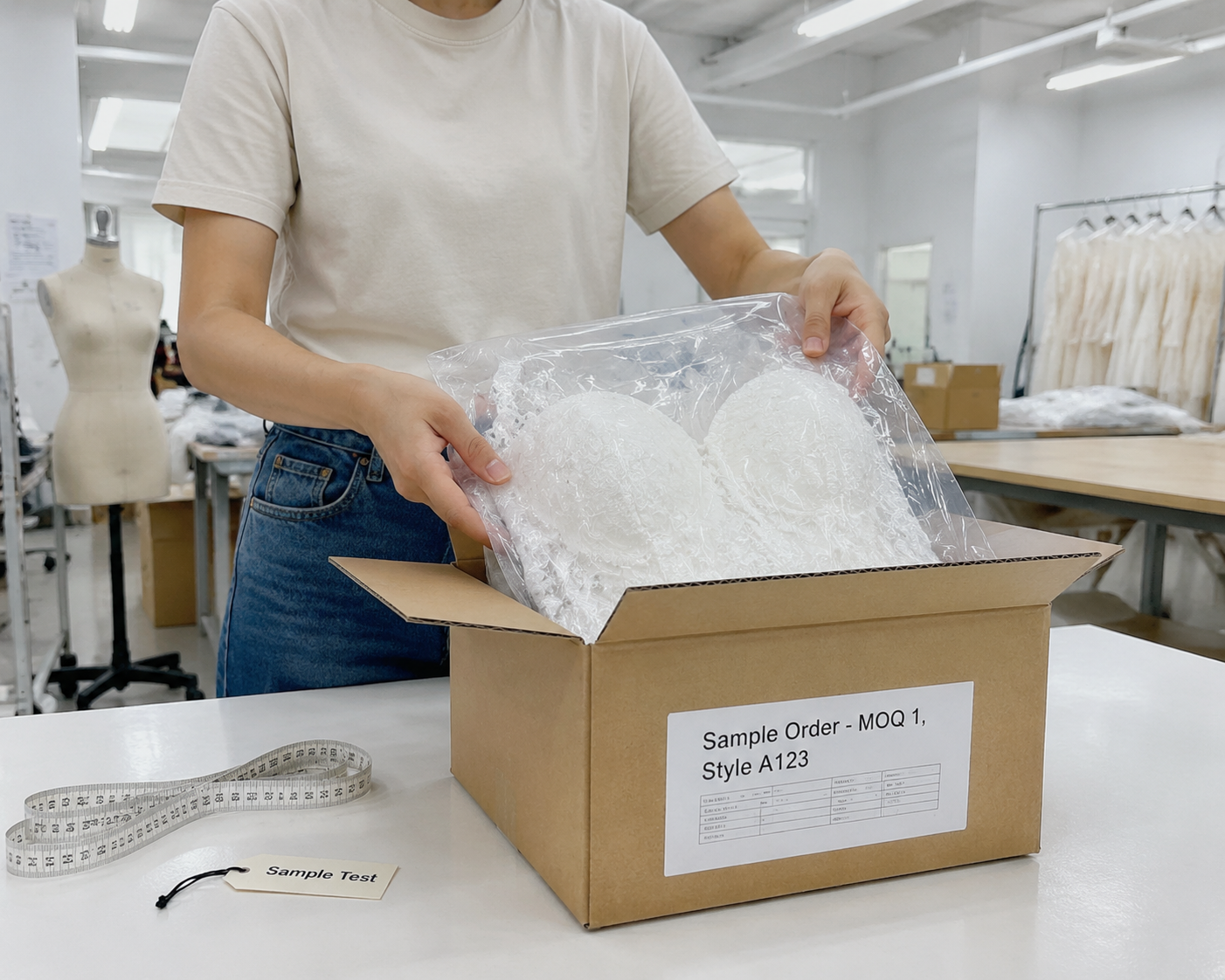
Many boutique buyers ask if small orders are possible. In our factory, we support MOQ 1 because bridal buying is not only about price. It is also about confidence. A bridal shop may want to test one A-line gown, one mermaid gown, and one ball gown before building a full collection. The shop may need to see whether local brides like the neckline, waistline, sleeve shape, fabric hand feel, and train length. No spreadsheet can replace a real dress in the fitting room.
| MOQ Choice | Benefit | Risk |
|---|---|---|
| MOQ 1 sample | Low inventory pressure and real quality check | Higher unit cost and higher per-piece freight |
| Small batch | Better cost control and more style testing | Some styles may sell slowly |
| Larger order | Lower average cost and stronger collection impact | Higher cash pressure and stock risk |
I have seen boutiques use one sample to make better choices. They inspect seams, lace placement, bead strength, zipper smoothness, corset support, inner finishing, and pressing quality. They then take photos, show brides, gather feedback, and reorder only the styles that create real demand. This process is slower than buying many pieces at once, but it can protect cash flow.
Small-order shipping is often expensive per dress. That is normal. One gown still needs packing, export work, and international movement. But the sample cost should be seen as part of product development, not only as a single sale. If the sample helps the shop avoid ten poor-selling gowns, it may save far more money later. This is why I do not push boutiques to order large quantities before they understand the style and supplier. A good import plan should match the buyer’s stage.
How can I compare quotes from different China wedding dress factories?
Two quotes can look similar, but they may not include the same work. I need to compare terms, quality, packing, and service, not only price.
I compare wedding dress factory quotes by checking trade term, included services, fabric level, structure, handwork, packing, production time, inspection process, payment terms, and shipping responsibility. The lowest price is not always the lowest risk.
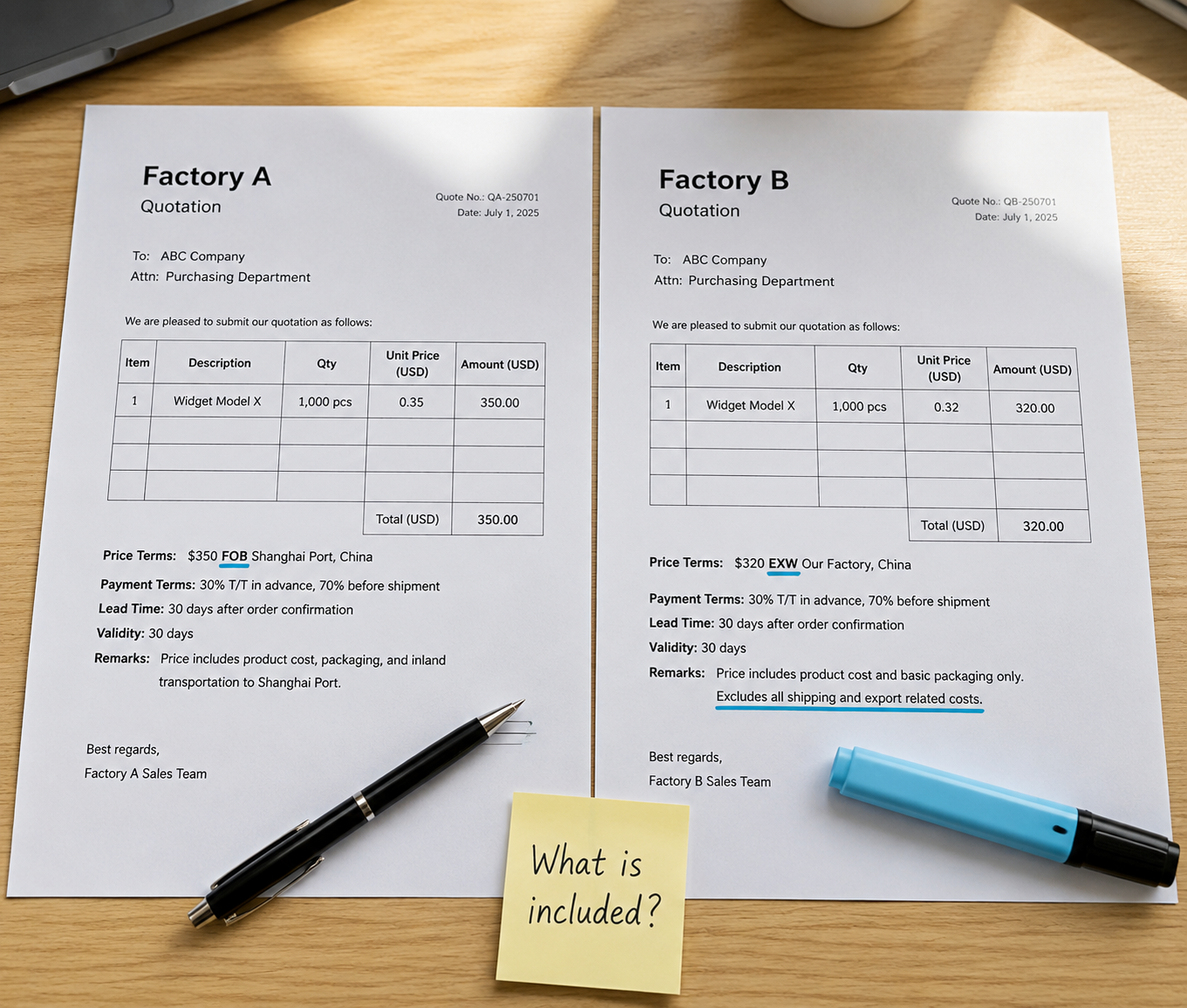
When a boutique sends the same style to several factories, the prices may be very different. This does not always mean one factory has a huge profit and another is cheaper. It may mean the factories are quoting different fabric grades, different lace, different internal structure, different handwork level, or different trade terms. One quote may be EXW, one may be FOB, and one may be DDP. These are not the same cost base.
| Quote Point | What I Check |
|---|---|
| Trade term | Is it EXW, FOB, DDP, or another term? |
| Fabric and lace | Are the materials equal in quality and weight? |
| Bodice structure | Does it include boning, cups, lining, and support? |
| Handwork | Is appliqué sewn well or only lightly attached? |
| Packing | Does it include garment bag, carton, and safe folding? |
| Lead time | Is the schedule realistic for bridal season? |
| Inspection | Are there checks during production and before shipment? |
| Communication | Does the supplier respond clearly and keep records? |
In our factory, we use a full production flow with cutting, sewing, hand appliqué, pressing, quality inspection, and finishing. We also use several inspection steps, including semi-finished inspection, finished inspection, and pre-shipment full check. We use needle detection equipment to check metal foreign objects. We also control color consistency, handwork accuracy, and decoration quality. These steps cost time and labor. They also reduce quality risk for the buyer.
I think quote comparison should include risk cost. If a boutique receives gowns with poor fit, wrong color, loose beads, or uneven hems, the cheap price may become expensive. The shop may need more alteration work. It may lose appointment trust. It may be unable to sell the sample at full value. A good factory quote should be clear enough for the buyer to understand what is paid for. I prefer a buyer who asks detailed questions, because clear questions often lead to better production results.
Conclusion
I always treat import cost as landed cost. A clear trade term, real cost sheet, and small test order help a boutique buy with less risk.